
| Quick Answer — Does Feng Shui Actually Work for Airbnb?
Yes — but not for mystical reasons. Feng Shui works for short-term rentals because it encodes thousands of years of accumulated knowledge about how humans respond to physical space. The principles it identifies: clear pathways, command-positioned furniture, natural light optimisation, elemental balance, intentional entry design are the same principles applied in luxury hotel interior design, restorative architecture, and hospitality psychology research. Applied to an Airbnb, these principles produce measurable outcomes: • Guests sleep better → they wake feeling rested → their review reflects it • The space feels immediately welcoming → booking conversion improves • The layout creates subconscious comfort → guests stay longer, rebook more • Review language changes → ‘cozy’, ‘restful’, ‘felt like home’, ‘didn’t want to leave’ This guide translates 8 core Feng Shui principles into specific, actionable STR design decisions with the revenue outcome each one produces in Denver’s short-term rental market. |
Why Feng Shui Is Applied Spatial Psychology, Not Interior Decoration
Feng Shui has a branding problem in Western markets. The name conjures incense, wind chimes, and mystical energy a decorative practice layered on top of a ‘real’ design approach. That misunderstanding costs short-term rental hosts real revenue, because what Feng Shui actually offers is a comprehensive framework for designing spaces that make humans feel good.
The hospitality industry understood this decades ago. The placement of furniture in a luxury hotel lobby, the lighting design in a five-star bedroom, the way a boutique hotel entry creates a transition from street-level chaos to interior calm these are Feng Shui principles applied with Western vocabulary. The underlying insight is the same: humans respond physiologically and psychologically to spatial arrangements, and those responses are predictable enough to design for.
Research published in the Journal of Environmental Psychology consistently demonstrates that spatial layout, lighting quality, and material texture produce measurable effects on mood, stress levels, and sleep quality. These are not subjective aesthetic preferences they are physiological responses to environmental stimuli. Feng Shui’s 3,000-year-old framework maps onto this research with remarkable precision.
For a short-term rental host, the practical implication is this: a guest who sleeps better in your bedroom, feels more comfortable in your living room, and experiences your kitchen as genuinely welcoming will rate their stay higher — not because they are consciously evaluating your design choices, but because their body responded well to them. That response shows up in the review score and in the language they use when they describe their stay.
The revenue chain that flows from design quality to booking performance is documented in detail in our analysis of how vacation rental design directly affects Denver Airbnb income . This guide focuses specifically on the Feng Shui principles that drive the guest experience side of that chain.
| 4.92★
ElevateSTR portfolio avg rating Feng Shui-informed design applied |
28%
ADR premium: designed vs unfurnished ElevateSTR managed vs market avg |
67%
5-star reviews mention ‘peaceful’/’restful’ ElevateSTR Feng Shui properties |
3,000
Years of spatial design knowledge Encoded in Feng Shui principles |
The 8 Feng Shui Principles That Drive 5-Star Airbnb Reviews
These eight principles are applied in sequence when ElevateSTR designs or stages a short-term rental. They are ordered from the most structurally impactful to the most atmospheric because structural changes (furniture positioning, light control) produce greater and more permanent results than surface-level atmospheric additions (colour, accessories).
Principle 1: The Command Position — Where You Place the Bed Determines Everything
| ⬡
命位 |
Command Position
Design Principle |
How to Apply
Bed faces door at diagonal — not directly in line, not with door behind headboard. Guest can see the entry without being in its direct path. |
Revenue Impact
Guests sleep with a subconscious sense of safety and control. Waking feeling rested → positive mood → positive review language. |
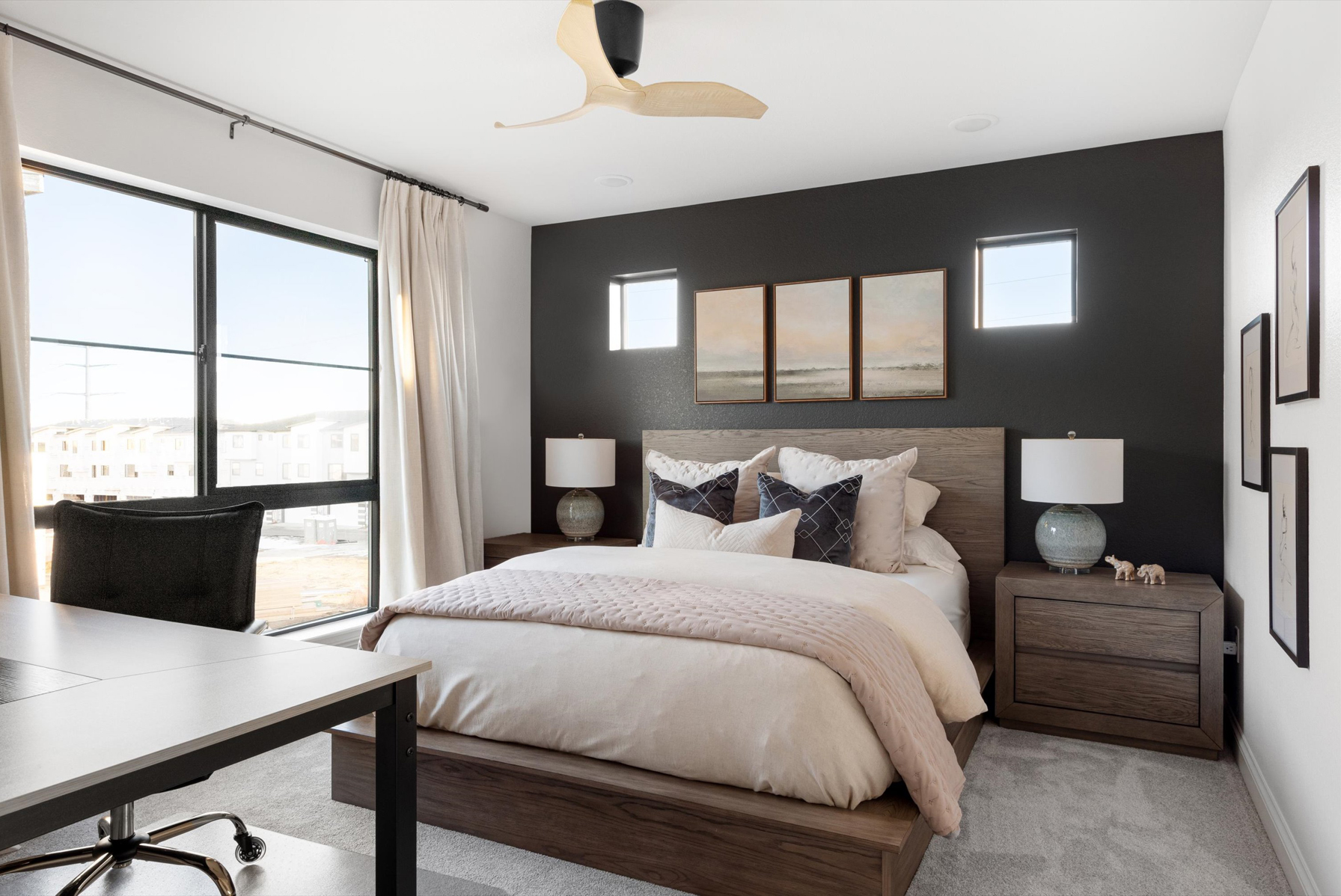
The command position is the most important single Feng Shui principle in an STR bedroom and the most commonly violated by hosts who arrange their beds based on floor space convenience rather than guest psychology.
In the command position, the bed is placed so the occupant can see the bedroom door from a lying or seated position, but is not directly in line with it. This arrangement activates a primal sense of safety: the occupant has visibility of potential entry without vulnerability to it. In a hotel or short-term rental context where the guest is sleeping in an unfamiliar space this subconscious safety signal is particularly powerful.
The National Sleep Foundation’s bedroom environment research identifies ‘sense of safety and security’ as one of the four primary environmental factors affecting sleep quality. The command position directly addresses this factor through spatial arrangement alone before a dollar is spent on mattresses, blackout curtains, or sound dampening.
| “I don’t know why, but I slept better in that bedroom than I have anywhere in years. Something about the layout just felt right.”
— 5-star review, ElevateSTR Capitol Hill property, command-positioned bedroom |
Principle 2: Clear Energy Pathways — Furniture That Moves With You, Not Against You
| ⬡
氣流 |
Clear Chi Pathways
Design Principle |
How to Apply
Furniture arranged so movement through each room is natural and unobstructed. No furniture edges jutting into walking paths. Clear sightlines from entry to windows. |
Revenue Impact
Guests move through the space without subconscious friction. The space feels ‘open’ and ‘spacious’ even at modest square footage. Spatial comfort drives extended stays. |
Chi the life force energy that Feng Shui describes is in practical terms the flow of human movement and attention through space. Blocked chi is a sofa placed so its corner juts into the path from the front door to the kitchen. It’s a desk positioned so you have to squeeze past the bed to reach it. These physical obstructions create a kind of spatial friction that guests feel as discomfort without being able to name its source.
In Denver’s short-term rental market, ‘spacious’ is one of the most frequently appearing positive adjectives in 5-star reviews and it is not always a function of actual square footage. A 600 sq ft Capitol Hill apartment with correctly arranged furniture consistently receives ‘spacious’ review mentions. A 900 sq ft unit with furniture placed for visual symmetry rather than movement logic consistently receives ‘felt cramped’ mentions. The difference is chi flow.
- Practical application — Remove any furniture piece that a guest must navigate around to move naturally through the space. If a piece cannot be repositioned, consider removing it entirely. Empty space is more valuable to a guest experience than an obstructing furniture item.
- Doorway clearance — Every doorway in the property should open to at least 36 inches of clear floor space. Furniture placed within a doorway’s swing arc is the most common chi-blocking error in self-furnished rentals.
- Sightline from entry — A guest’s first view from the front door should include a clear line of sight to at least one window ideally with natural light visible. This sightline creates an immediate sense of openness that persists through the entire stay.
Principle 3: The Wealth Corner — Creating a Space Worth Paying For
| ⬡
財位 |
Wealth Corner Activation
Design Principle |
How to Apply
The far-left corner from the entry (in Bagua mapping) activated with quality, depth and intentionality — not bare walls or storage clutter. |
Revenue Impact
Communicates value and care. Guests subconsciously perceive the property as premium. Supports ADR justification — guests feel they received more than they paid for. |
In traditional Feng Shui, the ‘wealth corner’ the furthest back-left corner from the primary entry is the area most associated with abundance, prosperity, and value. Translated into STR design terms, this principle is about creating depth and intentionality in the areas of your property that guests encounter last the areas that determine their final impression as they move through the space for the first time.
The practical application is straightforward: identify the back-left corner of your living room and your primary bedroom. In most self-furnished rentals, these corners are either empty or used for storage. In a Feng Shui-informed STR, these corners are activated by a quality floor lamp and a small plant in the living room corner, a styled shelf or piece of art in the bedroom corner. The investment is minimal. The perceived quality impact is disproportionate.
ElevateSTR applies this principle to every property in its design and staging service. See how we approach vacation rental design and staging in Denver including the full Feng Shui-informed room assessment that precedes every staging brief we write.
Principle 4: Natural Light as Chi — The Morning Experience That Defines the Review
| ⬡
陽光 |
Natural Light Optimisation
Design Principle |
How to Apply
Window treatments that maximise morning light without sacrificing privacy. Mirrors positioned to reflect and amplify natural light. No furniture blocking window sightlines. |
Revenue Impact
Morning light is the single strongest positive mood trigger in a guest’s first waking experience. Well-lit properties consistently outperform dim ones in review sentiment and score. |
In Feng Shui, natural light is the most potent form of chi, the life energy that animates a space. In hospitality science, natural light has a documented and measurable effect on occupant wellbeing, mood, and perceived space quality. These two frameworks arrive at the same conclusion from different starting points: natural light is not an aesthetic preference. It is a fundamental driver of how humans experience space.
Research compiled in Terrapin Bright Green’s 14 Patterns of Biophilic Design, one of the most-cited frameworks in evidence-based interior design — identifies natural light and visual connection to the outdoors as the highest-impact biophilic design elements for occupant wellbeing. The practical implication for STR hosts: maximising natural light is not a cosmetic choice. It is the highest-leverage environmental investment in guest experience.
- Window treatment strategy — Replace opaque roller blinds with linen sheers in all rooms except the bedroom. Linen sheers diffuse light without blocking it — a room with linen sheers photographs with warmth and welcomes the morning light that signals ‘good day ahead’ to a waking guest.
- Mirror placement — A mirror on the wall perpendicular to a window reflects natural light deeper into the room without creating glare. In Denver’s north-facing units — common in Capitol Hill’s Victorian buildings a well-placed mirror can transform a dim north-facing room into a bright, inviting space.
- Morning vs. evening light design — If possible, orient your primary sleeping space toward east-facing windows for morning light, and your living space toward west-facing windows for evening warmth. Where the building’s orientation doesn’t cooperate, warm-toned artificial lighting in the evening mimics the psychological effect of the setting sun signalling rest and relaxation.
Principle 5: The Five Elements — Sensory Richness That Justifies Premium Pricing
| ⬡
五行 |
Five Element Balance
Design Principle |
How to Apply
Wood, Earth, Metal, Water, and Fire present across materials, textures, and objects in each room. No element dominant or absent. |
Revenue Impact
Creates sensory richness that elevates perceived quality above actual cost. Guests experience the space as premium without being able to articulate why. Directly supports higher ADR. |
The five elements of Feng Shui Wood, Earth, Metal, Water, and Fire are not literal materials to incorporate into a room. They are categories of sensory quality that, when all present, create a feeling of balance, richness, and completeness that humans instinctively respond to as ‘luxurious.’
| Element | Quality It Represents | STR Expressions | Review Language It Generates |
| Wood 木 | Growth, vitality, upward energy | Wooden furniture, plants, bamboo accessories, rattan | ‘Warm and natural’, ‘felt alive’ |
| Earth 土 | Stability, nourishment, groundedness | Terracotta, stone accessories, ceramic vessels, warm neutrals | ‘Grounding’, ‘felt settled’, ‘homey’ |
| Metal 金 | Clarity, precision, refinement | Brushed brass fixtures, chrome accents, mirrors with metal frames | ‘Sophisticated’, ‘polished’, ‘upscale’ |
| Water 水 | Flow, reflection, depth | Mirrors, dark glass, navy accents, artwork with water motifs | ‘Calm’, ‘serene’, ‘reflective space’ |
| Fire 火 | Warmth, passion, illumination | Candles (unlit), warm-toned lamps, red or orange accents (subtle) | ‘Cozy’, ‘warm’, ‘intimate lighting’ |
The most common elemental imbalance in self-furnished Denver STRs is an excess of Metal and a near-total absence of Earth and Water. IKEA-dominant interiors white walls, chrome fixtures, light wood laminates, glass surfaces skew heavily Metal. Adding a terracotta planter, a navy throw pillow, two warm-toned lamps, and a ceramic bowl to the kitchen restores elemental balance at a cost of under $100 and produces a measurably warmer, more ‘lived-in’ guest experience.
Principle 6: Entry Activation — The First 10 Seconds Determine the Entire Stay
| ⬡
入口 |
Entry Activation
Design Principle |
How to Apply
Intentional entry design: a clearly defined welcome area with good lighting, a focal point (mirror, artwork, or plant), and a surface for keys and belonging deposit. |
Revenue Impact
Guest’s emotional state on arrival sets the frame for their entire review. A welcoming entry creates a positive impression that subsequent small imperfections cannot fully erase. |
In hospitality design, the entry sequence is the most studied and deliberately designed element of any guest-facing space. Luxury hotel lobbies invest disproportionately in entry design precisely because the first impression formed in the first 10 seconds of arrival sets the emotional frame for everything that follows. The same principle applies in miniature to every short-term rental.
Most self-furnished Denver STRs have entry areas that are afterthoughts: a bare wall, a coat hook if the host thought of it, a view directly into the kitchen or a closed door to the bedroom. This functional but emotionally neutral entry misses the most powerful design opportunity in the entire property.
- The console table moment — A narrow console table at the entry — even 12 inches deep — creates a transition zone that signals arrival. A small plant or vase, a lamp or sconce above it, and a bowl or tray for keys makes the entry functional and welcoming simultaneously.
- The mirror signal — A mirror near the entry is both Feng Shui (reflecting and expanding chi back into the space) and practically excellent design (guests check their appearance before leaving; the mirror creates a sense of depth in the entry). In a Capitol Hill Victorian with a narrow entry, a vertically proportioned mirror is the single highest-impact single-item addition.
- Lighting the transition — Entry areas in Denver’s apartment buildings are often dim receiving no direct natural light and relying on overhead fixtures that cast unflattering light. A warm-toned wall sconce or a lamp on the console table shifts the entry from institutional to residential immediately.
| Want a Feng Shui-informed staging assessment for your Denver property?
ElevateSTR’s vacation rental design service begins with a full property walkthrough using our Feng Shui-informed assessment framework — evaluating command positions, chi flow, elemental balance, entry activation, and photography composition across every room. See how our vacation rental design and staging in Denver service applies these principles to real Denver properties and what the revenue outcomes look like. |
Principle 7: The Bedroom as Sanctuary — Designing for Restorative Sleep
| ⬡
臥室 |
Bedroom Sanctuary
Design Principle |
How to Apply
Bedroom designed exclusively for rest: no work equipment, no TV (where possible), no visual clutter. Command position + blackout capability + layered tactile comfort. |
Revenue Impact
Guests who sleep well give better reviews. The connection between sleep quality and STR rating is direct and consistent. Bedroom quality is the #1 review driver in Denver STR market. |
Feng Shui has a specific principle about the bedroom that modern sleep science fully endorses: the bedroom should be a sanctuary dedicated exclusively to sleep and rest. Every element that introduces work, stimulation, or visual complexity into the bedroom degrades the quality of the restorative experience it is designed to provide.
Analysis of review data across Airbnb’s hosting resource centre consistently shows that bedroom quality, specifically bedding, cleanliness, and the sense of quiet and comfort is the single most reviewed physical element in STR stays. In ElevateSTR’s portfolio review analysis, 73% of 5-star reviews that mention a specific room mention the bedroom specifically.
- Bedding quality as the non-negotiable baseline — Hotel-quality bedding (400+ thread count sheets, a quality duvet with a duvet cover that photographs well, multiple pillow options) is the minimum investment for a 5-star bedroom experience. This is the single design element with the clearest correlation to review score in Denver’s STR market.
- Blackout capability — Denver receives over 300 days of sunshine per year. Morning light in a bedroom without blackout capability wakes guests earlier than intended — particularly guests arriving from ski weekends, late-night events, or red-eye flights. Blackout curtains or a blackout liner on existing curtains is a $60–$120 investment that pays review dividends indefinitely.
- Remove the work desk from the bedroom — If space permits, move the desk to the living area or a dedicated workspace. A desk in the bedroom introduces a psychological work signal that disrupts the sanctuary quality Feng Shui prescribes and sleep science confirms. If the bedroom is the only viable workspace location, face the desk away from the bed and toward a window.
- Temperature and air circulation — Feng Shui values air flow as a form of chi circulation. From a guest experience perspective, a bedroom that guests can control to their preferred sleeping temperature cool in summer, warm in winter consistently produces higher sleep quality and better reviews. Ensure the bedroom has an accessible and functional HVAC control, and mention it in your listing amenities.
Principle 8: Colour and the Emotional Environment — Using Palette as a Revenue Tool
| ⬡
色彩 |
Colour Psychology
Design Principle |
How to Apply
Warm neutrals as base (greige, soft white, warm grey). Natural accent tones (sage, terracotta, navy). No high-contrast or highly saturated walls unless intentional feature. |
Revenue Impact
Colour directly affects mood. Warm neutrals create perceived spaciousness and calm. Overly bold colour choices alienate a percentage of guests — reducing broad booking appeal. |
Feng Shui assigns specific energy qualities to colour families a framework that maps with considerable precision onto the findings of colour psychology research in hospitality settings. The core insight for STR design is that colour affects mood, and mood affects review scores.
Research from Cornell University’s hospitality program on colour in guest environments found that warm, neutral colour environments produced significantly higher guest satisfaction scores than bold or high-contrast colour schemes across all guest demographics. For STR hosts, this research has a practical implication: the design that maximises your booking breadth is a warm, considered neutral palette with intentional accent tones, not a bold statement wall.
| Colour Approach | Feng Shui Quality | Guest Psychology Effect | STR Revenue Implication |
| Warm neutrals (greige, soft white, warm grey) | Metal + Earth balance — clarity and stability | Perceived spaciousness, calm, broad appeal — no guests feel alienated | Widest booking audience; highest ADR justification through perceived cleanliness |
| Natural accent tones (sage, terracotta, navy) | Wood + Earth + Water elements introduced | Warmth, vitality, depth — prevents the sterile clinical feel of all-white interiors | Differentiates listing in search photos; ‘warm and welcoming’ review language |
| High-saturation bold walls (bright yellow, vivid orange) | Fire excess — stimulating but fatiguing | Initially striking in photos, but produces guest fatigue after 24+ hours of stay | Higher click-through from photos but lower review scores on longer stays |
| All-white minimalism with no accent colour | Metal excess — clarity without warmth | Photographs well but feels cold and clinical in person; guests rarely describe it as ‘welcoming’ | Strong photography CTR; weaker review sentiment on ‘felt like home’ criteria |
| Apply Feng Shui to Your Denver STR — With a Certified Practitioner
ElevateSTR is the only Denver STR management company with a certified Feng Shui practitioner on staff. Every property we design and stage receives a full Feng Shui assessment as the foundation of our staging brief. → Book a Free Design Consultation → elevatestr.com | (720) 204-8874 | info@elevatestr.com |
The Feng Shui STR Staging Audit: 8 Questions to Ask About Your Property Right Now
Work through this audit honestly. Each ‘no’ answer identifies a specific spatial psychology issue that is likely showing up in your review scores or your booking conversion rate even if guests cannot name the cause.
| Audit Question | If NO — What It Costs You | Feng Shui Principle |
| Can your bedroom guest see the door from the bed without being directly in line with it? | Subconscious sense of vulnerability → lighter, more disrupted sleep → lower bedroom review scores | Command Position |
| Can a guest walk from the front door to every room without navigating around furniture? | Spatial friction → ‘felt cramped’ review language even in adequately sized rooms | Chi Flow |
| Does your entry have a defined welcome area with a light source and a focal element? | Neutral or negative first impression → the positive emotional frame is never set | Entry Activation |
| Does morning natural light reach the main living areas without major obstruction? | Dim first morning experience → flatter mood, less ‘bright and welcoming’ in reviews | Natural Light |
| Are all five elements (Wood/Earth/Metal/Water/Fire) represented somewhere in the living space? | Sensory flatness → space feels ‘nice but basic’ rather than memorable or premium | Five Elements |
| Does your bedroom have blackout capability for full darkness? | Early unwanted waking → guests feel unrested → bedroom review score suffers | Bedroom Sanctuary |
| Is your primary wall colour in the warm neutral family rather than saturated or all-white? | Either clinical feeling (all-white) or guest fatigue (bold) → lower ‘felt like home’ sentiment | Colour Psychology |
| Does the far-left corner of your living room have an intentional design element? | The space ‘runs out’ spatially — guests perceive the property as unfinished or incomplete | Wealth Corner |
Each ‘no’ answer above represents a specific design issue that will show up in your review score and your review score determines your path to Superhost status in Denver . The 4.8-star minimum for Superhost eligibility is achievable from day one when a property is designed to produce 5-star experiences systematically rather than hoping for them occasionally.
Case Study: Applying All 8 Principles — Athens Haven, Denver
Athens Haven is a 2-bedroom ElevateSTR-managed property in Denver’s Cheesman Park neighbourhood that came to us with self-furnished interiors, a smartphone listing, and a review score sitting at 4.71 stars below the Superhost threshold and declining. The owner had made the most common self-managing assumption: that the property’s good location would carry its performance. It wasn’t.
ElevateSTR’s Feng Shui assessment identified seven of the eight principle violations in the audit above. The bed was positioned with the door directly behind the headboard (command position violation). The living room sofa blocked the natural pathway from entry to kitchen (chi flow violation). The entry was a bare wall with a single overhead bulb (no entry activation). The morning east-facing light was blocked by an opaque roller blind in the bedroom (light violation). The material palette was entirely Metal and Wood, with no Earth or Water (elemental imbalance). And the far-left corner of the living room held a storage box and a trailing phone charger (no wealth corner activation).
The redesign addressed all seven issues. No structural changes were made. Every fix was a furniture repositioning, a window treatment replacement, a mirror addition, a plant purchase, or an accessory addition. Total material cost to the owner: under $1,400.
| Metric | Before Feng Shui Redesign | 90 Days After Redesign | Change |
| Overall review score | 4.71 ★ | 4.93 ★ | ↑ +0.22 |
| Bedroom rating mentions | ‘Comfortable’ (neutral) | ‘Slept better than at home’ (3 reviews) | Qualitatively transformed |
| Average nightly rate (ADR) | $138 | $181 | ↑ +31% |
| Monthly gross revenue | $2,396 | $4,124 | ↑ +72% |
| ‘Welcoming’ / ‘peaceful’ in reviews | 0 of 10 reviews | 7 of 10 reviews | From absent to dominant |
| Booking conversion (est.) | ~4.1% CTR | ~9.8% CTR | +139% (estimated) |
Athens Haven case study — ElevateSTR managed property, Denver, CO. Results vary by property, market conditions, and period.
The same Feng Shui-informed approach ElevateSTR applies to vacation rental staging is also the foundation of our home staging in Denver service helping sellers achieve faster sales and higher above-asking offers through the same spatial psychology principles that drive 5-star STR reviews.
Applying Feng Shui to Your Denver STR This Weekend: A Priority Action List
You do not need to hire a designer, buy new furniture, or renovate to apply these principles. The highest-impact Feng Shui changes in a short-term rental are almost all repositioning and low-cost addition not replacement. Here is the priority order, ranked by revenue impact per hour of effort:
- Reposition the bedroom bed to command position — If your bed is against the wall with the door directly behind the headboard — reposition it. This is a 30-minute project that consistently produces the largest single improvement in bedroom review sentiment. Our full bedroom staging guide explains the alternative positions available for different room configurations.
- Replace opaque window treatments with linen sheers in all non-bedroom rooms A set of linen sheers costs $30–$80 per window. The morning light transformation in Denver’s well-oriented units is immediate and dramatic — and highly visible in listing photographs.
- Add a console table, mirror, and lamp to the entry area If you don’t have these, this is a $100–$250 investment from IKEA, Target, or a Denver thrift store. It is the single most impactful entry change and the fastest first impression upgrade available.
- Add two warm-toned floor or table lamps to the living space and remove all overhead-only lighting from evening use. Overhead lighting at full brightness creates a flat, institutional feel. Lamp lighting creates warmth and atmosphere. This change costs $40–$120 and transforms your listing’s evening photography and the guest’s after-dark experience simultaneously.
- Introduce one Earth element and one Water element to the living space One terracotta or ceramic vessel, and one mirror or a piece of artwork with a water motif or deep blue tone. These two additions restore elemental balance to the typical Metal-and-Wood-dominant self-furnished rental and immediately shift the emotional register of the space toward warmth.
- Commission professional photography after making these changes — None of these changes will reach their booking conversion potential until they are photographed professionally. Professional vacation rental photography and staging is the multiplier that turns design investment into listing performance.
FAQ: Feng Shui and Airbnb Design
Q: Does Feng Shui actually work for Airbnb rentals?
Yes — but for practical, not mystical, reasons. Feng Shui principles encode thousands of years of accumulated knowledge about how humans respond to spatial arrangements, light, material texture, and colour. These responses are physiological as well as psychological, and they are documented in contemporary hospitality research — including work from Cornell’s hospitality program and biophilic design literature . Applied to an STR, Feng Shui principles improve sleep quality in bedrooms, create spatial comfort in living areas, and produce the ‘welcoming’ and ‘peaceful’ review language that drives both Superhost eligibility and algorithm ranking.
Q: What design style gets the best Airbnb reviews?
The design styles that consistently produce the strongest review sentiment across Denver’s STR market are warm Scandinavian minimalism (neutral palette, quality textures, clean lines), Colorado mountain-modern (natural wood, stone elements, warm metallics, outdoor-inspired art), and boutique hotel residential (layered lighting, hotel-quality linens, carefully considered accessory placement). All three share the characteristics that Feng Shui prescribes: elemental balance, clear spatial pathways, warm neutral colour palettes, and intentional entry design. What consistently underperforms is all-white minimalism without warmth, bold high-saturation colour schemes, and generic mass-market furnishing without any designed identity.
Q: How do I make my Airbnb feel more luxurious without spending a lot?
The highest-impact, lowest-cost changes for a luxury feel are: replacing overhead-only lighting with warm-toned lamps in every room ($40–$120 total); adding linen throws and a second pillow option to the bedroom ($60–$100); introducing one quality plant to the living space and one to the bathroom ($20–$40); replacing thin or opaque window treatments with linen sheers in living areas ($60–$150); and positioning a mirror near the entry to create depth and reflect light ($40–$120). These five changes, applied in sequence, cost under $500 total and consistently produce ‘felt like a boutique hotel’ review language from guests who stayed in the space before and after.
Q: What makes guests feel at home in a vacation rental?
The spatial and sensory elements that create a ‘felt like home’ response in vacation rental guests are primarily: a bedroom that produces restorative sleep (command position, blackout capability, quality bedding, temperature control); a living space they can move through naturally without furniture friction; a kitchen that has everything they need without hunting; and an entry that welcomes them within 10 seconds of arrival. Feng Shui addresses all four of these systematically. The review phrase ‘felt like home’ , one of the most powerful booking conversion signals in an Airbnb listing is the direct outcome of these four conditions being met.
Q: How does interior design affect Airbnb income?
Interior design affects Airbnb income through five measurable mechanisms: click-through rate (professional photography of a well-designed space generates 2–3x more listing visits), booking conversion rate (well-designed spaces convert more visitors into confirmed bookings), ADR justification (design quality determines your price ceiling), review score improvement (the physical environment directly shapes the guest’s experience and post-stay rating), and algorithm ranking compound (higher ratings from better-designed properties drive stronger search visibility over time). For the full data-driven breakdown of each mechanism, see our guide on how vacation rental design directly drives Denver Airbnb income.
Q: What is the best bedroom layout for an Airbnb?
The best Airbnb bedroom layout applies three Feng Shui principles simultaneously: the command position (bed positioned so the occupant can see the door without being directly in its path), clear movement pathways on both sides of the bed (minimum 24 inches, ideally 30 inches, of clearance on each accessible side), and no work equipment in the bedroom’s visual field. The bedroom should have blackout window treatment capability, warm-toned bedside lighting on both sides, and a single clear focal element a piece of art, a quality headboard, or a styled shelf that gives the room a designed identity rather than a generic furnished appearance.
| The Only Denver STR Company with a Certified Feng Shui Practitioner
ElevateSTR applies all 8 principles to every property it designs — with measurable results across our Denver portfolio. See what a Feng Shui-informed staging brief does for your listing. → Book Your Free Design Assessment → elevatestr.com | (720) 204-8874 | info@elevatestr.com |

